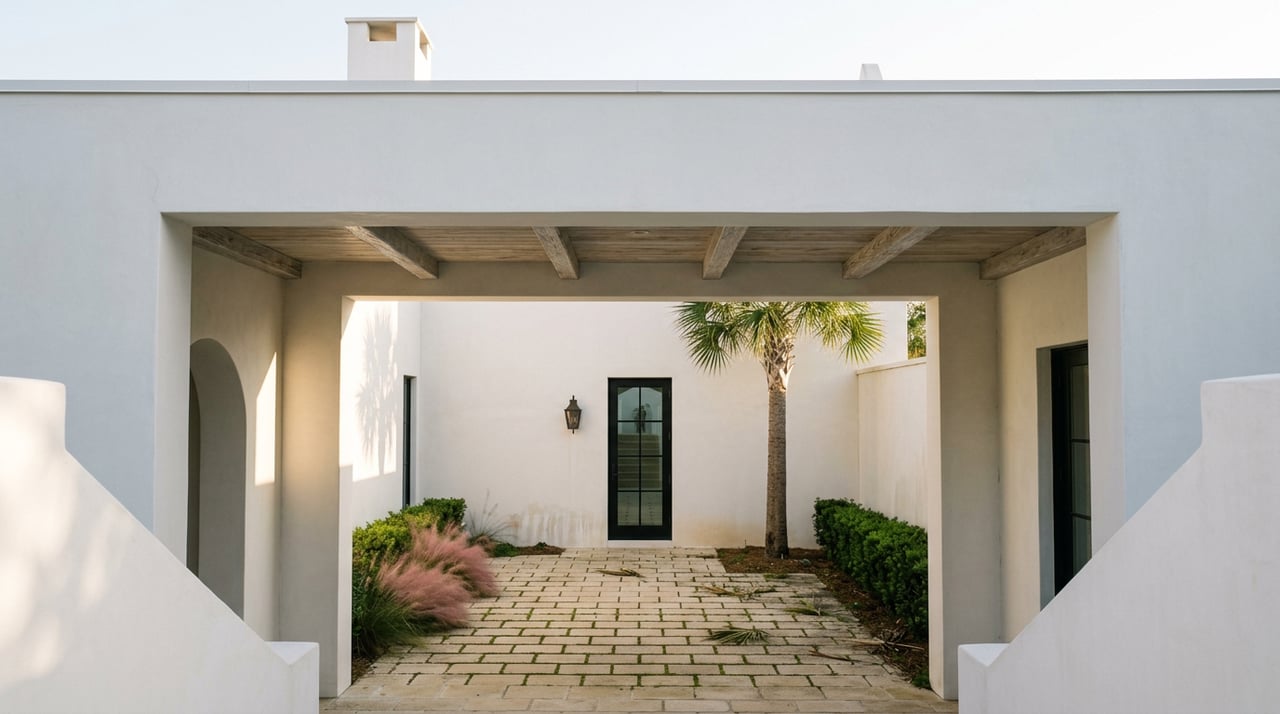
SoWal reported that prices per square foot in Alys Beach held steady or rose slightly while the wider 30A corridor cooled. In February 2026, 21 homes changed hands in Alys Beach, compared with 46 in February 2025. The report said some luxury properties were on the market for as long as 185 days by March 2026.
That is strange. Scarce, high-demand real estate is supposed to move fast, not slow down while holding its price. The obvious explanations do not fully hold up either. Mortgage rates eased into 2026, hovering around 6.2 percent, down from roughly 7 percent the year before, which should have helped absorb inventory everywhere along the coast. And the broader 30A market backs that up: corridor-wide inventory rose about 14 percent year over year heading into 2026, and buyers there gained real negotiating leverage as prices pulled back by roughly 11 percent.
Alys Beach did not follow that script. It held its value while somehow also getting slower to sell. The answer is not the architecture, the beach access, or the amenities. It is the fine print buyers agree to before they ever get a key.
The Fee That Changes Who Bothers to Buy
Every home in Alys Beach that participates in short-term rental has to go through Alys Beach Vacation Properties, the community's in-house management arm, and that program takes 40 percent of gross rental revenue. There is no option to bring in a third-party manager who might do it for 20 or 25 percent. Compare that to Rosemary Beach, just down the road, which allows a mix of architectural styles and lets owners choose their own third-party property manager.
That single structural difference reshapes who Alys Beach actually works for. Run the numbers on a typical three-bedroom courtyard home grossing somewhere between $120,000 and $145,000 a year in rental income, which is a commonly cited range for the community. Take out the 40 percent management fee and you are down to $72,000 to $87,000 before you have paid a single utility bill, cleaning fee, or HOA assessment. For an investor comparing that against a similar home in a community with open third-party management, Alys Beach starts to look like a worse trade the moment you run the spreadsheet.
That is the mechanism behind the slowdown. It is not that fewer people want to own in Alys Beach. It is that fewer buyers can justify the math quickly, which stretches out the sales cycle even while the scarcity of inventory keeps the asking price firm.
What Ownership Actually Costs Before You Rent a Single Night
The 40 percent fee is only one line in a longer list. Buyers typically owe a $30,000 non-refundable capital contribution and a 0.5 percent foundation fee at closing, on top of standard closing costs. Quarterly HOA dues run somewhere between roughly $3,100 and $3,560 depending on the lot and phase, which works out to well over $12,000 a year before anything else. Property tax on a $4 million assessment came to about $39,653 in 2025, based on a roughly 10-mill rate.
There is one place the math works back in the owner's favor. Every home in the community has to meet FORTIFIED construction standards, which means 8-inch CMU block walls, concrete roof tiles, and impact-rated glazing on every opening. That construction typically cuts wind and hail insurance premiums by 30 to 50 percent. A $3 million Alys Beach home often insures for $8,000 to $12,000 a year, while a comparable frame-built home in Seaside or Grayton Beach can run $15,000 to $22,000 a year. On a long hold, that insurance gap partially offsets the management fee drag. On a short one, it does not come close.
| Cost line | Typical figure |
|---|---|
| Capital contribution (one-time) | $30,000 |
| Foundation fee | 0.5% of purchase price |
| Quarterly HOA dues | ~$3,100 to $3,560 |
| In-house rental management fee | 40% of gross rental revenue |
| Insurance savings vs. frame construction | 30% to 50% lower premiums |
The Architectural Review Board Adds Time, Not Just Character
The white stucco, the courtyards, the consistent roofline: none of that happens by accident, and none of it happens quickly. Any exterior change, from a new build to a repainted wall to a swapped-out paver, goes through the Architectural Review Board. A realistic planning window for a major new home runs several months once you add design review on top of standard Walton County permitting. Conceptual comments from the board can take two to four weeks, the first formal review another two to six weeks after the submittal is complete, and revisions can add another two to eight weeks on top of that.
For an owner planning to hold for a decade, that timeline is a known cost of admission, the same way a co-op board interview is in New York. For an investor trying to get a property renovated and listed before peak season, it is a schedule risk that can eat into a full year of potential rental income.
Who the Math Actually Works For
Put the pieces together and a clear pattern emerges. Alys Beach rewards buyers who are not trying to make the numbers work in year one. If you are planning to hold for ten years or more, live in the home part of the year, and treat any rental income as a bonus rather than the point of the purchase, the fee structure and the review timeline are background noise. You get architectural consistency that protects resale value, lower insurance costs for the life of the home, and a level of predictability that a less controlled community cannot promise.
If you are underwriting the purchase primarily as a short-term rental play, the same features work against you. The 40 percent management fee compresses net yield in a way that is hard to engineer around, since there is no competitive bidding for management services the way there is in Rosemary Beach or other 30A communities. And a renovation or design tweak that could otherwise be turned around in a few weeks somewhere else can take months here.
None of this makes Alys Beach a bad investment. It makes it a specific one, built for a specific kind of buyer. The mistake is assuming the same purchase logic that works in a more flexible corner of 30A will translate directly here, then being surprised when the numbers do not land the way you expected.
Questions Buyers Ask Before Making an Offer
Can I use an outside property manager instead of the in-house program? No. Rental operations run through Alys Beach Vacation Properties, and the association's governing documents keep that structure in place. If flexible third-party management matters to your plan, it is worth comparing that specific point against other 30A communities before you write an offer.
How long should I budget for an ARB approval on a renovation? Plan for roughly two to three months at minimum for exterior changes, and longer, often stretching toward a year when combined with county permitting, for a full new build. Working with an architect and builder who already have Alys Beach experience tends to shorten the review cycles noticeably.
Does the community's strict design control actually protect value? The available evidence suggests yes for price stability. Even as the wider 30A corridor saw an 11 percent price pullback heading into 2026, Alys Beach held or slightly increased its per-square-foot values. The tradeoff is liquidity: homes there took meaningfully longer to sell over the same period.
If you are weighing Alys Beach against Rosemary Beach, Seaside, or another spot along the corridor and want someone who can walk through what the fee structure and review timeline actually mean for your specific plans, whether that is a family retreat, a long-term hold, or a rental property, Shannon Cartrett can help you run the real numbers before you write an offer. Request a free consultation and home valuation to start the conversation.
This article is general information, not legal, tax or financial advice. Consult a qualified professional about your situation.